Key Takeaway
Fire damage restoration cost in Pasadena, CA has no reliable flat rate because the final number depends entirely on an on-site inspection covering smoke residue boundaries, suppression water damage, HVAC contamination, contents condition, and whether the job crosses from cleaning into permitted reconstruction. A contained kitchen fire and a whole-house loss are completely different scopes. Expect a written, line-item estimate that separates emergency stabilization, restoration, and any rebuild work before you agree to anything.
There is no dependable flat rate for fire damage restoration in Pasadena, CA. An honest estimate starts with a safe on-site inspection and a written scope that separates emergency stabilization, smoke and soot cleanup, drying of the water damage left behind by firefighting efforts, contents work, structural repairs, and, when the loss goes that far, full reconstruction. What sets the cost is the condition of your specific house: where smoke residue traveled, how much water soaked in, what is hidden behind the finishes, and whether the job crosses from cleaning into rebuilding.
If you are reading this a few days after a house fire, or you are standing in a home that never burned but smells like it did, you are probably trying to figure out whether a number someone gave you is reasonable. This article walks through the cost drivers a real fire damage assessment looks for, how a scope becomes a line-item estimate, how your insurance claim fits, and the California rules that protect your money before you sign anything. You will not find a price for your home here, and you will understand why by the end.
How much does fire damage restoration cost in Pasadena, CA?

It depends on findings that can only be made in person. Restoration companies that hand you a firm price over the phone are handing you a guess dressed up as a quote. That is not caution on our part. It is that the assessment has not happened yet.
The current fire and smoke restoration standard, ANSI/IICRC S700 (First Edition, 2025), calls for an assessment that establishes the presence, intensity, and boundaries of smoke residue and odor across the structure, the HVAC system, other building systems, and the contents. Until someone has done that work in your house, nobody has the information needed to write a defensible scope, let alone price it.
An honest fire damage restoration estimate separates six things:
- Emergency stabilization (board-up, roof tarping, making the property safe and keeping weather from causing further damage)
- Smoke and soot cleanup, including odor removal
- Water extraction and structural drying of the damage caused by putting the fire out
- Contents: inventory, cleaning, storage, return
- Structural repairs to damaged assemblies
- Reconstruction, where the loss requires rebuilding
We do not publish a fire damage restoration cost for your home either, for exactly this reason. What we can do is tell you what moves the number, and what documentation you should have in hand before you agree to anything.
Restoration or rebuilding? Know which job you actually need before you talk cost
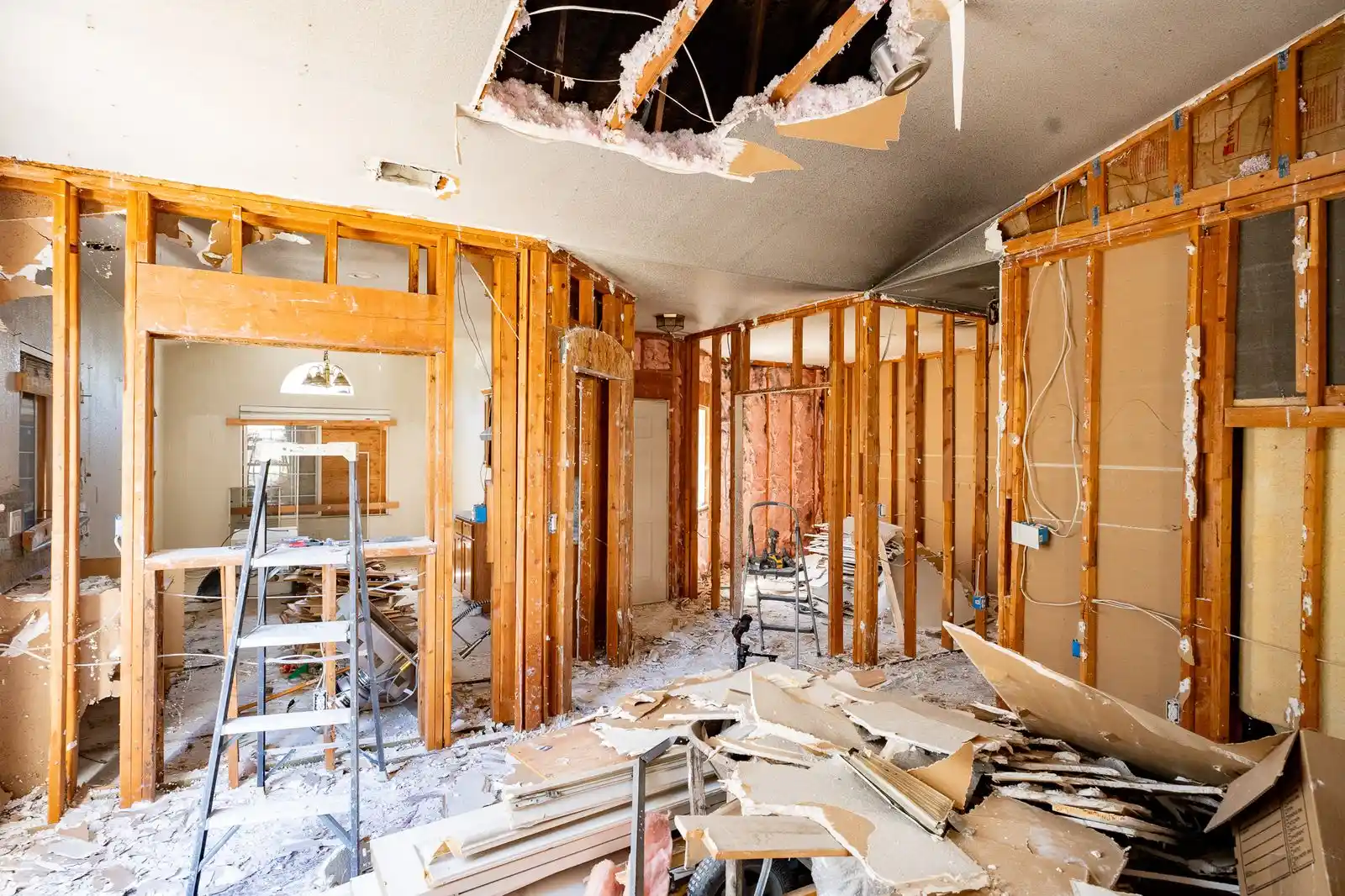
These two words get used interchangeably, and that confusion costs homeowners real money. They are different scopes of work with different documentation, different trades, and very different totals.
Restoration means emergency stabilization, cleaning, drying, removing the source of smoke odor, deodorizing, salvaging what can be saved, and repairing materials that are restorable. Reconstruction means replacing structural assemblies or rebuilding after a partial or total loss. The S700 standard covers assessment, mitigation, cleaning, contents, and fire-odor management. It expressly does not comprehensively cover reconstruction, because reconstruction is permitted construction work governed by building code.
One project can absolutely contain both phases. A contained kitchen fire may still call for a rebuild of that kitchen and restoration of the rest of the house. What should never happen is the two being folded into a single undifferentiated number.
| Phase | What it covers | What the paperwork should say |
|---|---|---|
| Emergency stabilization | Board-up, roof tarping, securing openings, making the site safe to enter | Itemized emergency restoration services, photos before and after, receipts kept for the claim |
| Restoration and mitigation | Soot removal, structural drying, smoke odor treatment, contents handling | Residue and moisture findings, room-by-room scope, drying logs, contents inventory |
| Structural repairs | Drywall, affected framing members, insulation, finishes | Line items by assembly and room, quantities from measurements |
| Reconstruction | Partial or total-loss rebuild, permitted and where required engineered | Fixed-price contract, plans, permit numbers, inspection milestones |
If an estimate buries a rebuild inside a restoration total, it is telling you very little about either one.
What determines fire damage restoration cost in Pasadena?

Cost follows scope, and scope follows findings. Here are the findings that move the number most.
How far did the smoke residue and soot travel?
Smoke spread follows air movement, not the fire line. It rises, cools, and settles in rooms the flames never reached, pulled along by pressure differences, open doors, and the building’s own airflow. What burned matters too: protein residue from a cooking fire, synthetic residue from plastics and electronics, and wood or paper residue all behave differently and call for different soot cleaning methods, from dry sponging to wet cleaning with the appropriate detergents. Professional soot removal is chosen surface by surface, not applied uniformly with one product. Minor smoke damage confined to one room is a modest scope. Residue across multiple rooms and on framing throughout a house is not. Across Pasadena and the wider Los Angeles area, plenty of standing residential properties that never caught fire still carried real smoke and ash exposure from nearby wildfire, and that exposure has to be assessed rather than assumed.
Did the HVAC system move the smoke residue through the house?
Return ducts pull smoke residue in. Supply ducts push it back out into rooms that were otherwise clean, which is how a moderate fire in one room can leave residue in bedrooms at the far end of the house. If the system ran during or after the fire, the inspection has to determine whether the ductwork, air handler, and coils carry soot contamination, and whether they can be cleaned, sealed, or need replacement. That single decision can change the scope meaningfully, and it is one of the more common omissions when two estimates do not match.
How much water damage did firefighting leave behind?
Water used to extinguish a fire is part of fire recovery, and it belongs inside the fire scope rather than being treated as a separate water damage job. The EPA advises drying water-damaged areas and materials within 24 to 48 hours to help prevent mold growth. That window is why extraction and structural drying start early rather than after the adjuster’s second visit, and why early drying limits secondary damage like swollen subfloor, cupped hardwood, and microbial growth inside wall cavities. Moisture does not stay where you can see it. It wicks under flooring and into framing, so hidden water damage is found with moisture meters and thermal imaging, not with a flashlight. Those readings belong in the file from day one.
What does smoke odor removal actually involve?
Odor is not a separate problem from soot. It comes from soot residue that has settled on and soaked into porous materials, so smoke removal has to start at the source: cleaning what can be cleaned and taking out what cannot. Only after that does treatment of the remaining air and surfaces make sense, using specialized equipment such as HEPA vacuums, air scrubbers, negative air machines, and hydroxyl generators or ozone treatment in unoccupied spaces, depending on the residue. Sealing charred framing is sometimes appropriate after cleaning, never instead of it. If an estimate lists deodorizing but no source removal, you are being quoted for masking, and the smoke odor tends to return when the house warms up or the humidity climbs.
What is behind the finishes, and what cannot be cleaned?
Charring on structural elements, compromised sheathing, and heat damage to connections are usually invisible until selective demolition opens things up. Some materials clean well. Porous materials that absorbed residue and odor often have to come out instead. Contents may need pack-out, off-site cleaning, and storage before return. Debris removal is its own line. And the older housing stock in Pasadena and much of Los Angeles County means a survey for asbestos-containing materials or an assessment for lead paint may be warranted before anything is disturbed.
| Cost driver | What the inspection looks for | Documentation you should receive |
|---|---|---|
| Affected area and rooms | Room-by-room extent of fire, heat, and residue | Labeled photos and a room-by-room scope |
| Residue type and boundaries | What burned, residue character, where the smoke spread stops | Written assessment findings and cleaning methods chosen |
| HVAC contamination | Ductwork, air handler, coils, filters | HVAC findings and a clean, seal, or replace decision |
| Suppression water damage | Moisture meter and thermal readings in cavities, floors, framing | Initial readings plus daily drying logs to a dry standard |
| Concealed structural damage | Charring, framing condition, connections | Photos of opened assemblies, engineer input where warranted |
| Contents | Salvageable vs. non-salvageable personal belongings | Written inventory, pack-out list, storage terms |
| Hazardous materials | Suspect asbestos materials, pre-1978 painted surfaces | Survey or test results and the rules that apply |
| Permits and code | Scope triggering permits or current-code requirements | Permit applications, plan review status, inspection cards |
| Restoration/reconstruction crossover | Where cleaning ends and rebuilding begins | Separate scopes and separate estimates for each phase |
Why a square-foot number cannot price a house fire
If you searched fire damage restoration cost Pasadena and landed on a table of square-foot figures, that table was not written about your house. Those tools exist because averages are easy to publish. The trouble is that square footage tells nobody:
- What kind of residue is on the surfaces, or how far the smoke spread
- Whether moisture is trapped in wall cavities or under flooring
- Whether the HVAC system distributed contamination
- Which personal belongings can be cleaned and which cannot
- What the framing looks like behind the drywall
- Whether asbestos or lead work practices apply
- What current code requires for the repairs you need
Fire classifications have the same limitation. A class describes fuel and the right extinguishing agent. It does not describe residue distribution, water damage, contents condition, or structural damage, so it cannot produce a predictable invoice. Labor and material costs also move with the market and with lead times on specific products. Two houses on the same Pasadena block, same square footage, same year built, can produce estimates that are not remotely comparable. No one lives in an average house.
The restoration process behind an honest fire damage restoration estimate

The California Department of Insurance describes a scope of loss as documentation of the degree of damage, the quality of the affected materials and workmanship, and the measurements needed to calculate quantities. A scope may not contain prices or calculated quantities at all. Those get added when the estimate itself is prepared. Scope first, price second. That order is the whole thing.
Here is the sequence you can check against whatever you are handed:
- 1. Safe-access determination. The initial inspection cannot begin inside an unsafe structure. Utilities, structural stability, and hazards get evaluated first.
- 2. Photographs, measurements, and moisture readings. The specialized equipment used here, moisture meters and thermal imaging, belongs at the beginning of the restoration process, not after a dispute. Photograph each room before cleanup begins, and keep the fire department’s incident report with your file.
- 3. Smoke residue and odor boundary assessment. Where the residue is, how heavy, and where it stops.
- 4. HVAC and contents assessment. Duct contamination, and a room-by-room look at belongings.
- 5. Restoration vs. replacement decisions, material by material. Documented, with the reasoning.
- 6. Written scope. Degree of damage, materials and workmanship quality, measurements.
- 7. Line-item estimate. The scope, priced line by line.
- 8. Adjuster review. Plus a documented supplement if concealed damage shows up during demolition, which it often does.
- 9. Written, signed change orders. Before any added work proceeds. Not after.
Keep your own claim diary alongside this. CDI recommends retaining correspondence, photographs, bids, invoices, and change orders, including receipts from the initial cleanup and any emergency work. It costs you nothing and it settles arguments later.
Will insurance cover fire and smoke damage restoration?
The California Department of Insurance lists fire and smoke among the perils typically covered by homeowners insurance, but your policy language controls the outcome of your insurance claim. Deductibles, limits, endorsements, and loss-settlement terms all vary. So does whether you are paid on a replacement cost value or actual cash value basis, which changes what lands in your account and when. Ask specifically whether you have building-code upgrade coverage, because repairs pulled up to current code can otherwise exceed what a policy pays.
If you are covered through the California FAIR Plan, note that it is a named-peril policy covering fire or lightning, internal explosion, and smoke. It does not include everything a traditional homeowners policy does, which is why some policyholders pair it with a Difference in Conditions policy. Mold is commonly excluded as an independent peril, though mold resulting from a covered event may be covered depending on the language. Read that section, or ask your agent to read it to you.
Is smoke damage covered if the flames never reached my house?
CDI has told insurers they cannot summarily deny a smoke claim without an appropriate investigation, and that where professional testing is warranted for a claim, the insurer should contract and pay for that testing. That matters for homeowners across Pasadena and Los Angeles whose houses stayed standing but took on smoke, soot, or ash. Coverage still depends on your policy and the facts of your loss. California’s framework for wildfire smoke testing and remediation is still developing, so check the current status with CDI rather than relying on anything you read secondhand.
Why your insurance company’s estimate and your contractor’s estimate differ
They are different documents written for different purposes by people with different information. A gap in the totals usually means a gap in the scope, so compare them line by line rather than end to end. If your insurance company recommends a contractor from its preferred vendor program, you are welcome to consider that company and equally free to hire someone else. On temporary housing: after a declared state of emergency, qualifying California policyholders have at least 24 months of additional living expense coverage, with a 12-month extension available for qualifying reconstruction delays outside their control and further six-month extensions possible for good cause. The dollar limit can still run out before the time does. We cover claims handling and ALE in more depth in our California fire insurance claim guide.
California rules that protect you before you sign with a restoration contractor

You have more protection than you probably realize, and none of it requires a lawyer to use.
- Verify the license. Take 60 seconds and run the license number through the CSLB license lookup. It shows status, classification, bond, and any disciplinary history. The City of Pasadena tells fire-affected owners to verify the state license, get estimates from at least three contractors, and use a written contract.
- Get it in writing. California requires a written home improvement contract for projects over $500.
- Licensure thresholds. A contractor generally must be licensed when the combined contract value is $1,000 or more, and licensure is independently triggered when the work requires a permit or uses employee labor. Fire damage restoration and reconstruction almost always meet one of those triggers.
- Down payment cap. The down payment cannot exceed 10% of the contract price or $1,000, whichever is less. Anyone asking for a few thousand dollars up front before work begins is outside that rule.
- Progress payments. Payments cannot exceed the value of work completed or materials delivered. You pay for work that exists.
- Change orders. Any change to scope or price goes in a written, signed change order.
One more thing, and it is the one we care about most: a deadline to sign is a red flag. “This price is only good through Friday” has no place in fire recovery. A contractor who wants your work should be comfortable with you taking the estimate to two other restoration companies. Ours are.
How long do I have to cancel, three days or seven?
It depends on whether your loss came from a declared disaster. General qualifying home improvement and home solicitation contracts carry a three-business-day right to cancel, or five business days if the homeowner is 65 or older. But for repair or restoration of a residence damaged by a declared disaster, CSLB guidance gives homeowners seven business days to cancel without penalty. That is a meaningful difference if you signed something in the first week after a wildfire.
Declared-disaster rebuild work carries another protection: CSLB treats it as home improvement and requires a fixed-price contract. Time-and-materials and cost-plus contracts are not permitted for that work, and the usual down-payment and progress-payment limits still apply. This applies to qualifying declared-disaster projects, not to every unrelated residential fire, so confirm which category your loss falls into.
Pasadena permits, current code, and hazardous-material testing
These belong in an article about fire damage restoration cost because they sit inside the scope, not outside it. Permits, code edition, and testing all shape what has to be done and how long it takes.
Pasadena routes fire-related plan review and permitting through its Permit Center and Fire Engineering Division, and requires proof of an appropriate California contractor’s license for contractor-submitted fire plans. California’s 2025 Title 24 building standards took effect January 1, 2026, though what actually applies to your fire damage repair or rebuild is determined by the local authority and the scope of your project. Worth knowing: residential properties inside City of Pasadena limits and properties in unincorporated Altadena and other surrounding communities fall under different jurisdictions, with different permit paths.
On hazardous materials, South Coast AQMD notes that fire-damaged demolition and renovation can still require a prior asbestos survey and applicable Rule 1403 notifications, and that even structures built after 1984 may contain asbestos-containing products. The EPA’s Lead Renovation, Repair and Painting rule applies to qualifying renovation or partial demolition in pre-1978 housing and requires lead-safe certified firms and work practices. Testing is not automatic in every home. It is warranted based on the age of the property, the materials present, and what the work will disturb.
Pasadena also runs a fire-rebuild fee waiver covering many City plan-check and permitting fees for qualifying owner-occupied homes and condominiums red-tagged as a result of the January 7, 2025 Eaton Fire. It excludes certain outside-agency and water-service charges and currently retains a reduced, refundable $1,000 construction and demolition waste deposit. The eligibility rules are narrow and address-specific, so confirm your property’s status with the City directly rather than assuming. Our Pasadena fire rebuilding and permit guide goes deeper on the process.
How to compare fire damage restoration estimates without just picking the lowest

The City of Pasadena recommends getting at least three estimates. That advice only helps if you compare them by what is included rather than by the number at the bottom. Restoration companies working in Pasadena and Los Angeles draw on the same labor market, the same materials, and often the same estimating software, so a large gap between bids is usually a gap in scope rather than a gap in value. Go through each one and ask whether all three cover:
- The same affected rooms and building assemblies
- HVAC inspection, cleaning, sealing, or replacement
- Contents inventory, pack-out, cleaning, and storage
- Structural drying with daily moisture monitoring to a dry standard
- Demolition and removal of materials that cannot be cleaned
- Smoke odor treatment, including source removal rather than masking
- Structural repairs, and separately, any reconstruction
- Testing, permits, and plan review
- Debris removal and disposal
- Completion documentation and final inspections
- Payment milestones tied to work completed
When one estimate is dramatically lower, it usually is not a better deal. It is a shorter list. The omitted work does not disappear; you meet it again later as a change order, at a point when you have less leverage and fewer options.
When specialized fire damage restoration services are worth it, and how to reach us
The difference between a fire damage restoration company and a general remodeler is not a matter of skill or good faith. It is technical and legal. Fire work requires reading residue, drying suppression water inside a fire scope, treating smoke odor at the source, and knowing which contents can be saved. On the legal side, permitted construction requires proper licensure, code-compliant repairs, and inspections that hold up.
The other thing a specialist brings is knowing exactly where restoration ends and reconstruction begins, and writing those as separate scopes so your insurance claim file and your project both stay clean. Here is where that shows up in the work itself:
| What fire recovery requires | General remodeling or handyman work | Licensed fire restoration specialist |
|---|---|---|
| Smoke residue and odor assessment | Rarely part of a remodeling scope | Presence, intensity, and boundaries of residue documented across structure, HVAC, and contents, per ANSI/IICRC S700 |
| Water left by firefighting | Often treated as a separate job, or left out | Extraction and structural drying inside the fire scope, with daily readings to a dry standard and the EPA’s 24 to 48 hour window in mind |
| Smoke odor | Sealing or deodorizing applied over residue | Source removal first, then treatment of remaining surfaces and air with the appropriate equipment |
| Personal belongings | Usually not handled | Written inventory, salvage decisions, pack-out, cleaning, storage, and return |
| Asbestos and lead | Varies widely | Survey or testing arranged where property age and disturbed materials warrant it |
| Permitted repairs and rebuild | Depends on license status and classification | Licensed California General Contractor, permitted work, inspections at milestones |
| Claim documentation | Often a single lump-sum bid | Room-by-room scope, photos, drying logs, line-item estimate, documented supplements |
| Restoration vs. reconstruction | Frequently folded into one number | Written as two separate scopes with separate estimates |
Golden Coast Construction & Restoration works from a permanent local office serving Pasadena, CA and the wider Los Angeles area. We are IICRC certified and licensed as a California General Contractor, CSLB #838443, which you can verify yourself on the CSLB lookup before you call us. Our services include 24/7 emergency board-up, smoke cleanup and soot removal, structural drying, contents work, and reconstruction after major loss. A fire restoration company should be willing to show you all of that in writing, so we work directly with insurance adjusters, run QA inspections at milestones, arrange asbestos or lead testing where the property warrants it, and provide a signed certificate of completion at the end. Payments follow the milestone rules, not our preference.
Losing a home to fire is hard in ways that have nothing to do with construction. When you are ready, we will come look at the property, document what we find, and give you a written scope you can take to two other companies. No deadline attached.
Frequently Asked Questions
What is the average cost to rebuild a house after a fire?
There is not a usable average, and applying one to your property would mislead you. Rebuild cost turns on the structure itself, the code edition in effect, permit and plan review requirements, and how much of the building survived. Rebuilding is also a different scope from restoration, so the two should not be compared. An honest figure requires an on-site inspection, and anyone quoting a firm price sight unseen is a red flag.
How long does fire damage restoration take?
Think in phases rather than dates. Emergency stabilization happens within hours. Drying is governed by the 24 to 48 hour window and continues until monitored readings reach a dry standard. Smoke cleanup and odor removal run days to weeks depending on the affected area. Reconstruction is paced by plan review, permits, and material lead times. A firm timeline offered before anyone has inspected the house is a guess.
How do you estimate fire damage restoration cost?
You inspect and document first: photos, measurements, moisture readings, and the boundaries of smoke residue and odor. Then you decide material by material what gets cleaned and what gets replaced, write the scope, and only then price that scope line by line. Scope first, price second. Any estimate produced in the opposite order is working backward from a number.
Can a house with fire damage be repaired?
Often, yes. What it takes to repair fire damage depends on the structural condition, how deeply residue and smoke odor penetrated the materials, and the insurer’s loss determination. That call gets made on site, with a structural engineer or the building department involved where the damage warrants it.