Key Takeaway
Fire damage restoration cost in Roseville typically falls between $3,083 and $52,031 according to HomeAdvisor’s 2026 national cost guide, but no verified local average exists. Your actual cost depends on how far smoke and water traveled, whether structural repairs are needed, and what your insurance policy covers. An on-site inspection is the only way to get a defensible number.
There is no verified Roseville average for fire damage restoration, and any page that hands you one is guessing. The only defensible published figure we will put on this page comes from HomeAdvisor’s 2026 cost guide, which reports professional fire and smoke remediation falling anywhere from $3,083 to $52,031. That is national context, not a quote for your house. An honest fire damage restoration cost for your property requires an on-site inspection that separates emergency stabilization and cleanup from any structural reconstruction, and anyone who gives you a firm price sight-unseen is showing you something you should pay attention to.
This is written for a homeowner in or near Roseville who is holding an estimate, or waiting for one, and trying to tell whether it is fair. We will walk through how a fire and smoke damage estimate is actually built, what your insurance company changes about your out of pocket cost, and which California rules protect you before you sign anything.
How much does fire damage restoration cost in Roseville?

Restating it once with the attribution: according to HomeAdvisor’s 2026 national cost guide, professional fire and smoke remediation is reported in a range of $3,083 to $52,031. That spread is enormous for a reason. The low end of it is a few thousand dollars, roughly the shape of professional soot removal in one room after a contained stovetop fire with minor smoke damage. The high end is a house fire that left charred framing, water damage through two floors, and personal belongings that have to be inventoried and packed out.
We looked for a credible Roseville-specific dataset on fire damage restoration cost and did not find one. The local pages that publish city ranges rarely show their sample size or collection method, and at least one still leans on 2024 figures while mixing cleanup and rebuilding in the same table. Those are two different kinds of work with different labor, different licensing, and different insurance treatment. A national average cost also cannot account for damage severity, current material costs, or how far the smoke spread inside your walls.
So here is the honest version. A fire damage restoration cost is not a single number. It is a documented scope with measured quantities attached to it.
Why per square foot pricing fails after a fire
A price per square foot is easy to publish and easy to compare, which is exactly why it shows up in advertising. It fails here because two 2,000 square foot houses can carry completely different scopes. A per square foot rate cannot tell you whether the smoke damage stopped at the hallway or rode the return air duct into every bedroom, how much water the fire department put into the structure, or whether contents cleaning and storage are in the price at all. If a bid is built on a per square foot figure rather than measured quantities, ask what it assumes and what it leaves out.
Restoration, repair, and reconstruction are not the same scope
This distinction runs through the rest of the article, so it is worth setting straight now. The ANSI/IICRC S700 standard, first published in 2025, covers assessment and restoration cleaning after building fires: fire residue, odor, HVAC systems, contents, documentation, and the restoration work plan. It does not comprehensively cover reconstruction, and its current scope excludes wildfire. That is the industry itself drawing a line between cleaning a home and rebuilding one.
| Scope | Purpose | Examples |
|---|---|---|
| Emergency stabilization | Prevent further damage from weather and entry | Board-up, roof tarping, temporary repairs |
| Restoration and repair | Clean, dry, deodorize, salvage, and repair restorable areas | Soot cleanup, smoke odor work, structural drying of suppression water, contents cleaning, limited repairs |
| Reconstruction | Rebuild damaged structural elements or a total loss | Framing, roofing, electrical, plumbing, drywall, finishes, full rebuild |
If your estimate blends all three into one line, there is nothing in it you can check. You cannot compare it to a second bid, and your adjuster cannot match it against a scope of loss. Many restoration companies will group them by habit, so ask to see restoration services and reconstruction priced separately.
Why no one can price a house fire from a phone call or photos

The California Department of Insurance describes what a scope of loss has to document: the degree of damage, the quality of materials and workmanship, and the measurements needed to calculate quantities. A phone call produces none of those. And a good deal of fire damage is not visible at all until selective demolition begins and someone opens a wall.
What photos and square footage can’t show
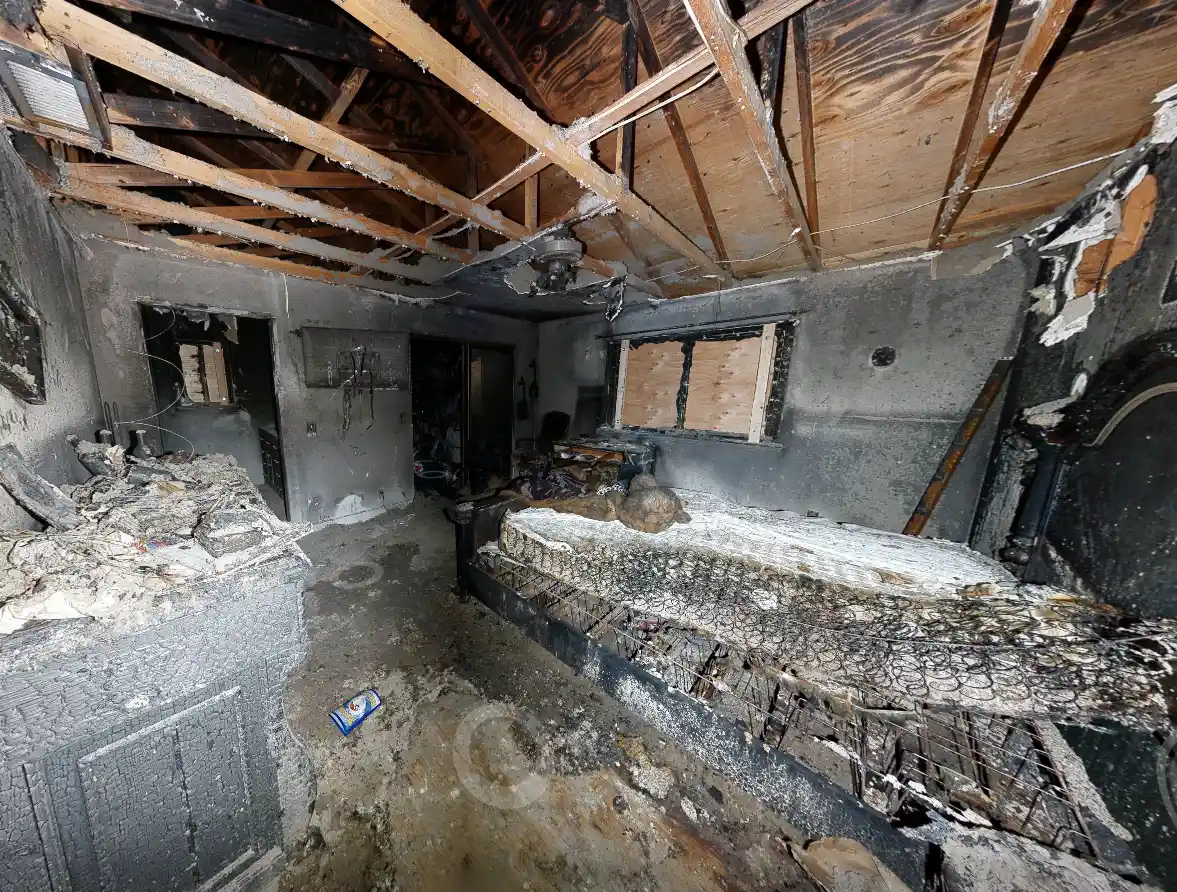
Soot travels where air travels. A photo shows you a stained wall. It does not show the cavity behind it, the HVAC return that pulled smoke residue into the ductwork, or the standing water that soaked into the subfloor while the fire was being knocked down. Square footage tells you nothing about which materials burned, how much personal property is in the house, or where the suppression water ended up.
Why “minor, moderate, severe” categories mislead
Those tiers put wildly different houses into one price band. A small kitchen fire that pushed heavy protein residue through the ductwork can easily out-scope a larger fire that stayed contained in a detached garage. A room the flames never reached can still have significant damage. A high estimate is not automatically wrong. An undocumented estimate is simply unverifiable, which is a different problem.
What determines your fire damage restoration cost
Smoke damage: how far the smoke and soot traveled
What burned determines how the residue behaves and which cleaning method works on it. Class A fires involving wood, paper, and cloth leave dry, powdery soot. Protein residue from a kitchen fire smears. Electrical fires and synthetic material fires leave an oily film that bonds to surfaces and calls for different chemistry. Porous materials absorb smoke particles, which is why smoke cleanup sometimes means removal instead of cleaning. Smoke and soot settle behind cabinets, inside wall cavities, and along HVAC pathways, so the affected area needing smoke damage restoration is almost always larger than the burn room. Wherever fires occur in a house, the residue rarely stays put.
Water damage from firefighting efforts
The water that put the fire out is part of fire recovery, and that water damage belongs in the same scope as the fire and smoke damage. Left wet, it produces secondary damage in the form of swollen subfloor, delaminated cabinetry, and mold. The EPA advises drying water-damaged materials within 24 to 48 hours where it is safe to do so, to reduce the likelihood of mold growth. Structural drying and moisture mapping should appear in the estimate in writing, with the affected assemblies named.
Structural damage and structural repairs
Heat changes wood before it consumes it. Affected framing, trusses, and load paths sometimes need a structural engineer’s evaluation, and that finding can move a job from restoration into reconstruction. Extensive structural repairs carry their own permits, inspections, and trades. When the assessment finds them, the scope gets rewritten. It does not get stretched.
Contents and personal property
Inventory, pack-out, cleaning versus replacement decisions, and storage are separate line items with real labor behind them. Whether contents are inside or outside the contractor’s scope changes the bottom line more than almost anything else on the estimate, so confirm which it is.
Debris removal, asbestos, and lead
Plenty of homes around Roseville and the greater Sacramento area predate current material standards, and hazardous materials change how the job is sequenced. The EPA advises that suspected asbestos-containing materials should not be disturbed and may require trained professionals. Under the EPA’s Renovation, Repair and Painting rule, paid work disturbing more than six square feet of painted surface in many pre-1978 homes requires certified lead-safe practices, with limited provisions for emergency work. Testing where warranted protects the household and keeps the job from stopping cold three weeks in.
Permits, code-compliant repairs, and access
Current code generally applies to the portion being rebuilt, which can mean electrical or smoke alarm work that did not exist before the fire. Containment, available power, and whether anyone is living in the home all change how the work has to be sequenced.
The professional fire damage restoration process, step by step

Cost follows scope, and scope follows the work that actually has to happen inside your house. Here is the order most fire restoration services run in, so you can see where the hours go.
- Emergency stabilization. Board-up, roof tarping, and temporary repairs so the loss stops growing. This is its own scope, billed separately, and it happens before cleanup begins.
- Assessment and documentation. Room-by-room inspection, moisture readings, residue identification, photographs, and measurements. This is the record your insurance adjuster compares against.
- Water extraction and structural drying. Suppression water is removed, saturated materials are dried or taken out, and specialized equipment logs readings until the assemblies reach a dry standard.
- Professional soot removal. HEPA vacuuming, dry sponge work on light residue, wet cleaning where the surface allows, and removal of porous materials that cannot be cleaned.
- Smoke odor treatment. HVAC cleaning, sealing of structural surfaces where residue cannot be fully extracted, and deodorization to treat smoke odor that remains.
- Contents. Inventory, pack-out, cleaning, storage, and return.
- Repairs and reconstruction. Drywall, paint, flooring, cabinetry, and any structural repairs, with permits and inspections where required.
- Final walkthrough. Quality checks at milestones, then a signed certificate of completion for your file.
A word on thermal fogging and ozone treatment
Thermal fogging heats a deodorizing solution into a fine vapor that follows the same paths the smoke took, into cavities and porous surfaces. Ozone treatment oxidizes odor molecules in a sealed, unoccupied structure. Both are finishing tools, not shortcuts. If a company proposes thermal fogging or ozone treatment before the smoke and soot have been physically removed, the smell tends to return once the treatment fades. The EPA also cautions that ozone is a lung irritant, which is why people, pets, and plants have to be out of the building during ozone treatment and the space ventilated before anyone returns. Ask which deodorization method is planned, whether thermal fogging or something else, and why it fits your residue type.
What a complete fire damage restoration estimate should include
The California Department of Insurance makes a useful distinction: a scope of loss is not the same thing as a finished estimate. The scope may leave out prices and calculated quantities entirely. It describes what happened and what is affected. The estimate is what a restoration company builds on top of that, with quantities and pricing attached.
A complete one should show you:
- Room-by-room scope, including cavities, attic, and HVAC where affected
- Measurements and quantities, not lump sums or a flat per square foot rate
- Cleaning versus replacement decisions, with the reasoning written down
- Who handles contents, and whether storage is included
- Who pulls permits and who pays the fees
- Hazardous-material assumptions and what triggers testing
- What is explicitly excluded from the price
- Allowances and any items still unresolved
- The change-order process, in writing, before work starts
- Start and completion expectations
- Progress payments tied to work completed
- Final inspection and completion documentation
Those items are what make total restoration costs checkable instead of a leap of faith. You are allowed to ask for every one of them in writing before you sign anything.
How insurance affects your out of pocket cost

Your deductible comes off first, and after that the numbers depend on your policy language more than on your contractor. It is also normal for an adjuster’s first figure and a contractor’s estimate to differ without anyone acting in bad faith. The insurance company wrote a scope from an initial inspection. The contractor measured, opened assemblies, and found more. That gap is handled through a supplement, which is the documented request to add damage that was not in the original scope. Our fuller California fire insurance claim guide walks through the sequence.
Actual cash value vs. replacement cost
The California Department of Insurance defines replacement cost as the amount needed to replace damaged property with similar kind and quality, without deducting for physical depreciation. Actual cash value reflects depreciation. Contents fall under your personal property coverage and are commonly paid first at actual cash value, with the remaining balance available after you actually replace the items, if your policy provides replacement cost value coverage.
Additional living expenses and temporary housing
If your home is unlivable, your policy’s additional living expenses coverage is what pays for temporary housing. After a declared catastrophe, CDI describes a collection period of 24 months, potentially extending to 36 with qualifying extensions. Keep in mind the policy’s dollar limit can be exhausted well before that clock runs out.
Why your lender may control the repair funds
On a mortgaged home, the structure check is commonly payable to both you and your lender. CDI notes that lenders may hold those funds in escrow and release them in stages as work is completed, sometimes requiring inspections before final release. Approval from the insurance company is not the same as money in your account, and a contractor who understands that will build a payment schedule that works with it.
On smoke claims specifically, CDI has directed insurers to fully investigate rather than summarily deny, since a fire loss can involve flame, heat, smoke, soot, ash, and debris. Statewide standards for wildfire smoke inspection and remediation are still being formalized, so ask for inspection findings and the exact policy provision behind any limitation, in writing.
California rules that protect you before you sign
These are the things a neighbor who does this for a living would tell you across the fence.
- Verify the license the same day. Run the number through the CSLB’s license lookup and confirm the name on the license matches the name on the contract.
- Get at least three written bids. CSLB recommends comparing bids based on the same plans, specifications, and scope. Different scopes are not comparable numbers.
- Written contract over $500. California requires a written home improvement contract above that amount. A license is generally required at $1,000 in combined labor and materials, and can still be required below that when a permit or employees are involved.
- Down payment cap. No more than 10% of the contract price or $1,000, whichever is less. That applies to qualifying disaster rebuild work too.
- Progress payments follow the work. Payments should track work actually completed or materials actually delivered, not a calendar.
- Cancellation windows. Generally three business days for qualifying home solicitation contracts, five business days for buyers 65 or older, and seven business days for qualifying repair or restoration contracts in a declared disaster area. Exceptions apply, so check yours rather than assuming the three-day rule covers you.
Two more, plainly. Do not sign your insurance check over to a contractor. And if someone tells you the price is only good until Friday, that is a reason to slow down.
Do you need a permit to repair fire damage in Roseville?
Usually, yes. The City of Roseville states that structures generally may not be altered, repaired, removed, or demolished without a permit unless a specific exemption applies. What the job requires for plan review and inspections depends on its scope, and the Building Division is who confirms that for your specific address. Not an online calculator, and not a contractor’s guess.
Permit fees should appear as a line item in your contract, with the responsibility for pulling them clearly assigned. Unpermitted fire repairs tend to surface later, either during the claim or when you sell, and they are more expensive to fix after the drywall is closed.
How to compare estimates from every restoration company you call
CSLB’s advice to gather three bids only works if all three describe the same job. A professional restoration company will hand you a scope you can actually read. Use these questions on each one:
- Are all affected rooms, wall cavities, and the HVAC system included?
- Is restoration separated from reconstruction, with its own line items?
- Are contents in or out of this price?
- Are permits and any hazardous-material testing named specifically?
- Is the payment schedule tied to completed work?
- How are supplements documented and submitted to the insurance company?
- Is the license current and in the same name as the company on the contract?
- Who performs quality checks at each milestone?
The lowest number and the best value are frequently not the same estimate. The cheapest bid is often the one missing a scope item that will show up later as a change order.
Frequently Asked Questions
What is the average cost to rebuild a house after a fire?
A rebuild is reconstruction, not restoration, and there is no defensible published rebuild average we are willing to put on this page. It depends on the structure, the code that applies to the rebuilt portion, and your policy’s dwelling limit. That number comes from an on-site assessment and plans.
How long does fire damage restoration take?
Duration follows the scope, not a damage category. The sequence is stabilization first, then drying of water damage from suppression within the EPA’s 24 to 48 hour window where it is safe to do so, then cleaning and repair, then any reconstruction with its permits and inspections.
How do you estimate fire damage costs?
Document affected areas room by room, measure for quantities, identify where the smoke and water actually stopped, decide clean versus replace with a stated reason, note hazardous-material and permit assumptions, then price that scope. CDI describes the same core elements: degree of damage, quality of materials and workmanship, and the measurements needed to calculate quantities.
Does homeowners insurance cover smoke damage restoration?
Smoke is a covered peril under most standard policies, and CDI has directed insurers to fully investigate smoke claims rather than deny them outright. Soot damage on surfaces the flames never touched is still part of a fire loss. Coverage still turns on your specific policy language, so ask your insurance company for the inspection findings and the provision behind any limitation, in writing.
Can a house with fire damage be repaired?
Most fire-damaged homes can be repaired. The real question is whether the affected assemblies are restorable or have to be rebuilt, which is an assessment finding rather than a sales opinion. And if flames never reached a room, the smoke damage there can still be part of the claim.
Getting an honest number from a licensed fire damage restoration company
Golden Coast Construction & Restoration keeps a permanent office in Roseville serving the Sacramento area, and we work fire losses only, from emergency board-up through reconstruction. Our California General Contractor license is CSLB #838443, and we would rather you verify it yourself through the CSLB lookup than take our word for it. We are IICRC-certified, available 24/7 for board-up and roof tarping, and we write a documented scope suitable for your insurance claim, working directly with your adjuster.
An emergency board-up does not obligate you to hire us for restoration services or reconstruction. Honestly, we would rather you compare three comparable bids than sign quickly. What a licensed fire restoration specialist gives you over a handyman is specific: scope documentation your insurance company can match, permitted repairs that meet current code, IICRC-based cleaning and drying procedures, milestone payments tied to completed work, quality inspections along the way, a signed certificate of completion, and asbestos or lead testing where warranted.
When you are ready, ask us for an on-site assessment. That is where a real number starts.