

Key Takeaway
Whether a fire damaged roof needs repair or replacement depends on whether the damage reached the deck, rafters, trusses, or connectors beneath the shingles. Intact-looking shingles can sit over a scorched deck or heat-weakened framing, so the decision requires a layer-by-layer on-site inspection. Replacement becomes more likely when structural components are affected, damage is widespread, or a repair cannot meet current code. No one can give you a reliable answer from a photo or a phone call alone.
A fire-damaged roof can often be repaired when the damage is isolated and the decking, framing, and connections underneath are still structurally sound. Replacement becomes more likely when fire or heat has reached the deck, rafters, trusses, or connectors, when the fire damage is widespread, or when a limited repair can’t meet code. If you’re standing in your yard looking up at a roof that saw flames, heat, embers, or firefighting water, that uncertainty is one of the hardest parts of the whole thing. Here’s the honest truth up front: no one can give you a real final answer from a photo or a phone call. The extent of the fire damage drives the decision, and that takes an on-site inspection to confirm. And the single most important idea in this article is this: don’t decide by looking at the shingles alone.
Why You Can’t Decide From the Shingles Alone

A roof isn’t one thing. It’s a stack of layers, and fire treats each one differently. From the outside in, you have the covering (shingles, tile, or membrane), then underlayment and flashing, then the deck or sheathing, and below that the structural framing: rafters, trusses, and the metal connectors that hold them together.
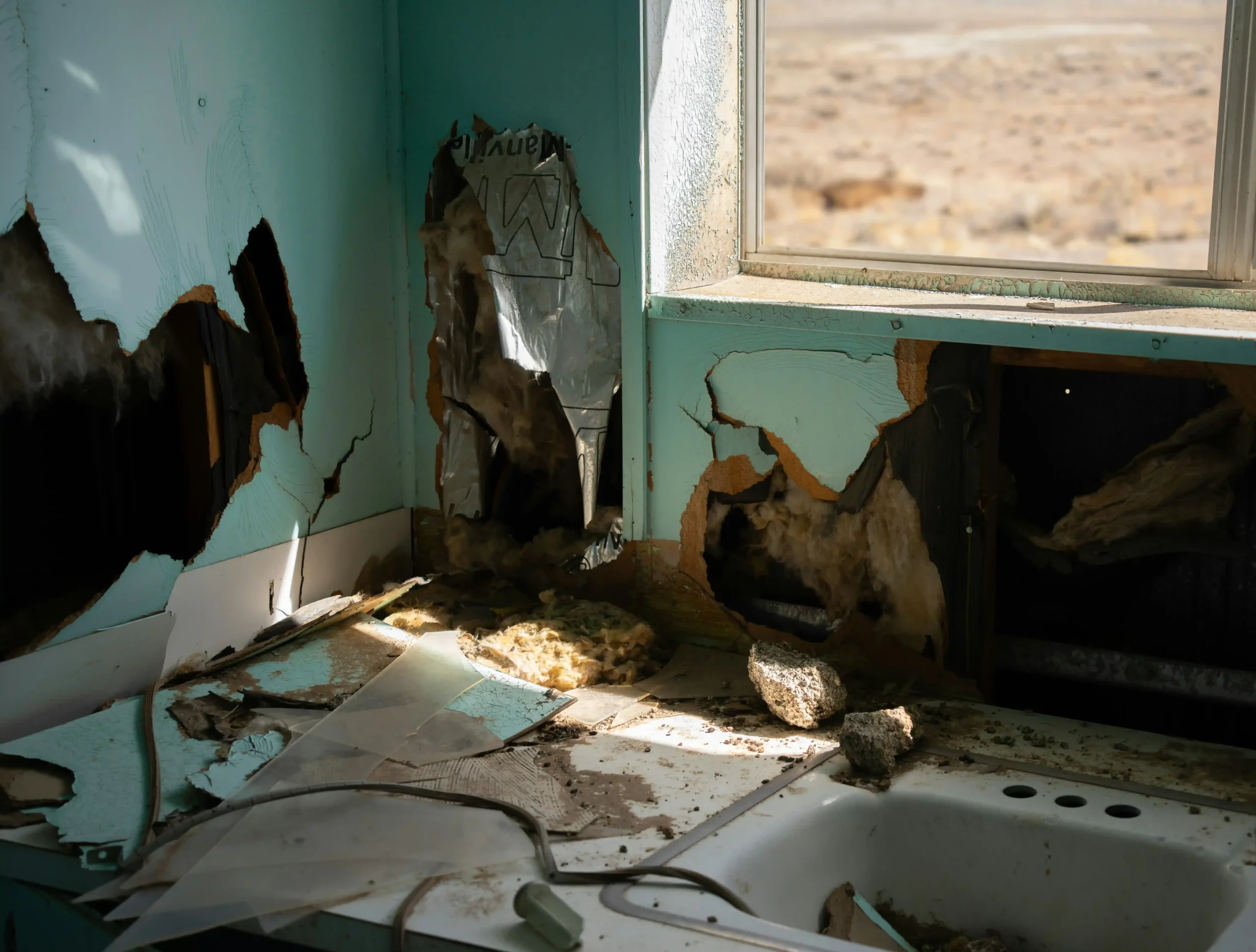
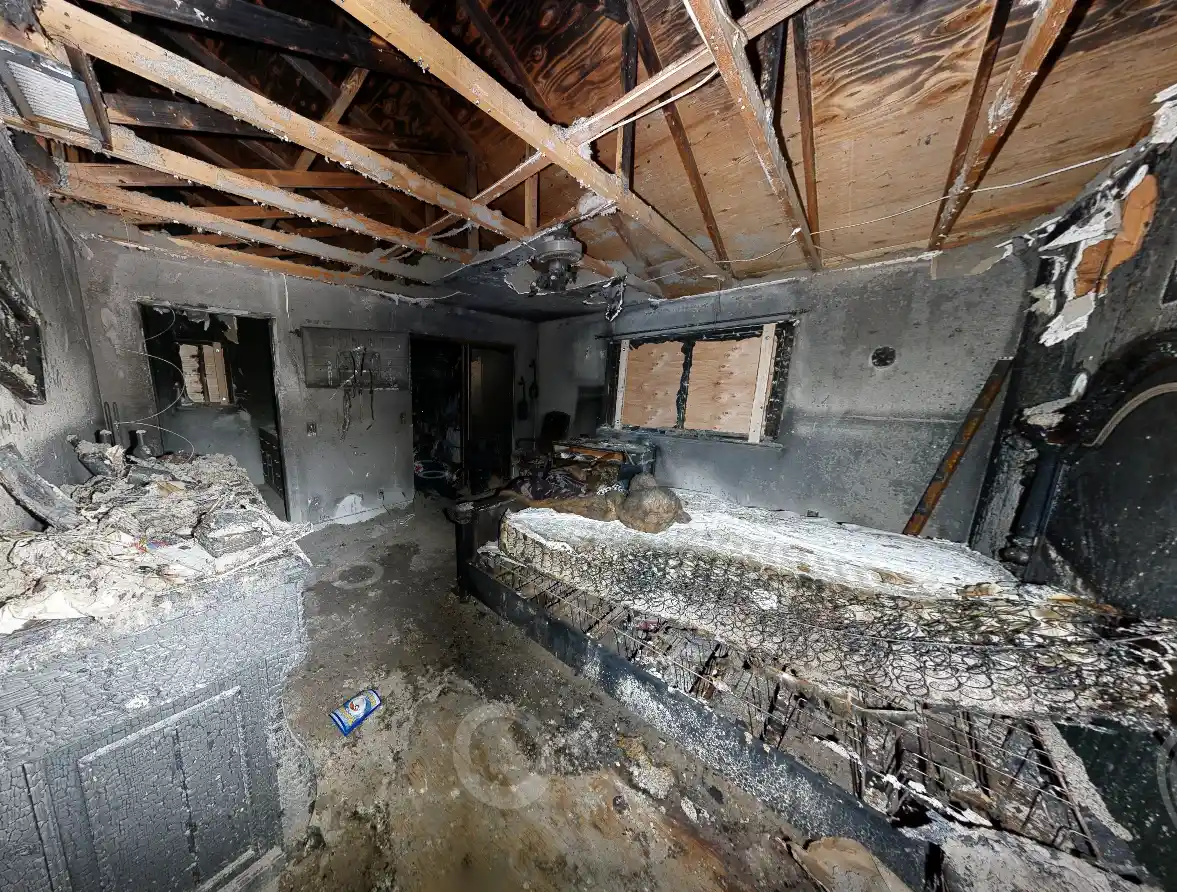
Intact-looking shingles can sit directly over a scorched deck or heat-weakened framing. Heat can reduce the strength of wood and metal connectors without leaving an obvious mark on the surface above them. Fire also rarely arrives alone. Smoke and soot settle into the attic and insulation, and the water used to put the fire out can saturate decking, insulation, and framing. A fire damaged house roof that looks fine from the street may be hiding several of these conditions at once, and the water damage from suppression hoses is often the part owners underestimate. That standing water, left in place, is also how mold growth starts within 24 to 48 hours, which is why drying to prevent mold growth is part of the job and not an afterthought. The repair-or-replace question has to be answered layer by layer, not at a glance.
Don’t Climb a Fire-Damaged Roof. Do This First.
Before anything else: wait for the fire department or your local building authority to release the property, and follow any posted occupancy restrictions. A roof that held weight yesterday may not hold yours today. Stay clear of sagging rooflines, unstable chimneys, damaged electrical wiring, and wet or bulging ceilings.
The California Department of Insurance advises property owners to take reasonable temporary steps to prevent further damage, like covering roof openings with plastic sheeting or plywood, to save receipts, and to hold off on extensive permanent repairs until the adjuster has assessed the loss. Professional temporary tarping and board-up does two jobs at once: it keeps weather out, and it preserves the fire damage evidence your claim depends on. A DIY climb can undo both. For the details of that step, see our guide to emergency roof tarping and board-up after a fire.
Three Separate Questions a Fire-Damaged House Roof Raises
Most confusion after a roof fire comes from treating one question as if it answers all of them. It doesn’t. There are three, and they’re decided by different people.
- Is it structurally safe? A structural engineer, architect, or qualified restoration contractor evaluates the residual capacity of the framing.
- What repair will meet current code and manufacturer requirements? A licensed contractor working with the local building department answers this.
- What will the insurance policy cover and pay? Your insurance company decides this, within your policy terms.
No single party answers all three, and an insurance estimate is not a structural assessment. Here’s who decides what:
- Fire department or building official: whether you can enter or occupy the property
- Engineer or architect: residual structural capacity and repair details
- Licensed contractor: detailed scope, permits, and construction
- Insurance company: what the policy covers and pays
- Building department: code compliance, inspections, and final approval
What a Complete Fire and Smoke Damage Inspection Should Include
A proper assessment means getting into the attic, not just walking the exterior. Visible damage is only part of the picture, and the concealed components are where fire does its quiet work. A thorough inspection should check:
- Roof covering (shingles, tile, membrane)
- Flashing and valleys
- Roof deck or sheathing
- Rafters and roof trusses
- Truss plates, fasteners, hangers, and connectors
- Eaves, fascia, and soffits
- Attic insulation and ventilation
- Chimney and roof penetrations
- Electrical wiring, HVAC system components, and solar equipment
- Smoke and soot damage on sheathing, drywall, and attic walls
- Firefighting-water saturation (measured with moisture meters, not guessed at)
- Possible asbestos or lead disturbance
Moisture meters matter here because water can saturate insulation and decking without showing a stain, and a sagging ceiling is a sign the assessment needs to go deeper before any roof repairs are scoped. The inspection should also map how far smoke damage reached, since soot travels well beyond the burned area and settles into the attic and the top of interior walls. Where the blaze started matters too: kitchen fires tend to leave greasy protein residue that carries a strong odor, while smoldering, low-oxygen fires leave wet smoke, a sticky soot damage that smears and demands different cleaning of the affected materials.
When a Limited Roof Repair May Be Reasonable

Repair is often the right answer, and a good contractor should tell you so when it is. A limited repair tends to make sense when:
- The damage is confined to a clearly defined affected area
- The surrounding material is still serviceable
- The deck and structural framing are sound
- The repair can follow the roofing manufacturer’s requirements
- The finished repair can be made genuinely weather-tight
- Matching and local code requirements can be met
- Any structural repair has an approved engineered detail
No single visible condition guarantees repairability, and anyone who gives you a repair-or-replace verdict based on a quick look at the shingles is skipping the part that protects you. This list is what keeps you from accepting a patch that leaves hidden fire damage in place. Repairing fire damage on a roof is only honest when the layers beneath the covering have been confirmed sound. A small section of scorched covering over sound framing is a very different job than a charred deck across the whole house.
When a New Roof or Full Replacement Is More Likely
Replacement, partial or full, becomes the more likely path when the damage reaches past the covering. Conditions that point that way include:
- Burned-through or widely charred decking
- Reduced or distorted rafters and framing
- Damaged truss plates or connections
- Sagging, movement, or separation at the framing
- Widespread suppression-water saturation
- Existing roof layers or deterioration that prevent a legal recover
- Materials that can’t be safely removed or matched
- Current code requirements that expand the scope
- Damage crossing several roof planes or structural breakpoints
High heat can also weaken metal fasteners and connectors even where the wood looks acceptable. You may see a percentage rule online, often around 25 to 50 percent, that supposedly triggers full replacement. Some local jurisdictions do use area thresholds in their code, but that’s a local building rule, not a universal test for fire-damaged framing. One more honest tipping factor: when the cost of a sound repair approaches the cost of a new roof, full replacement is usually the better value.
Can Charred Rafters or Roof Trusses Be Repaired?
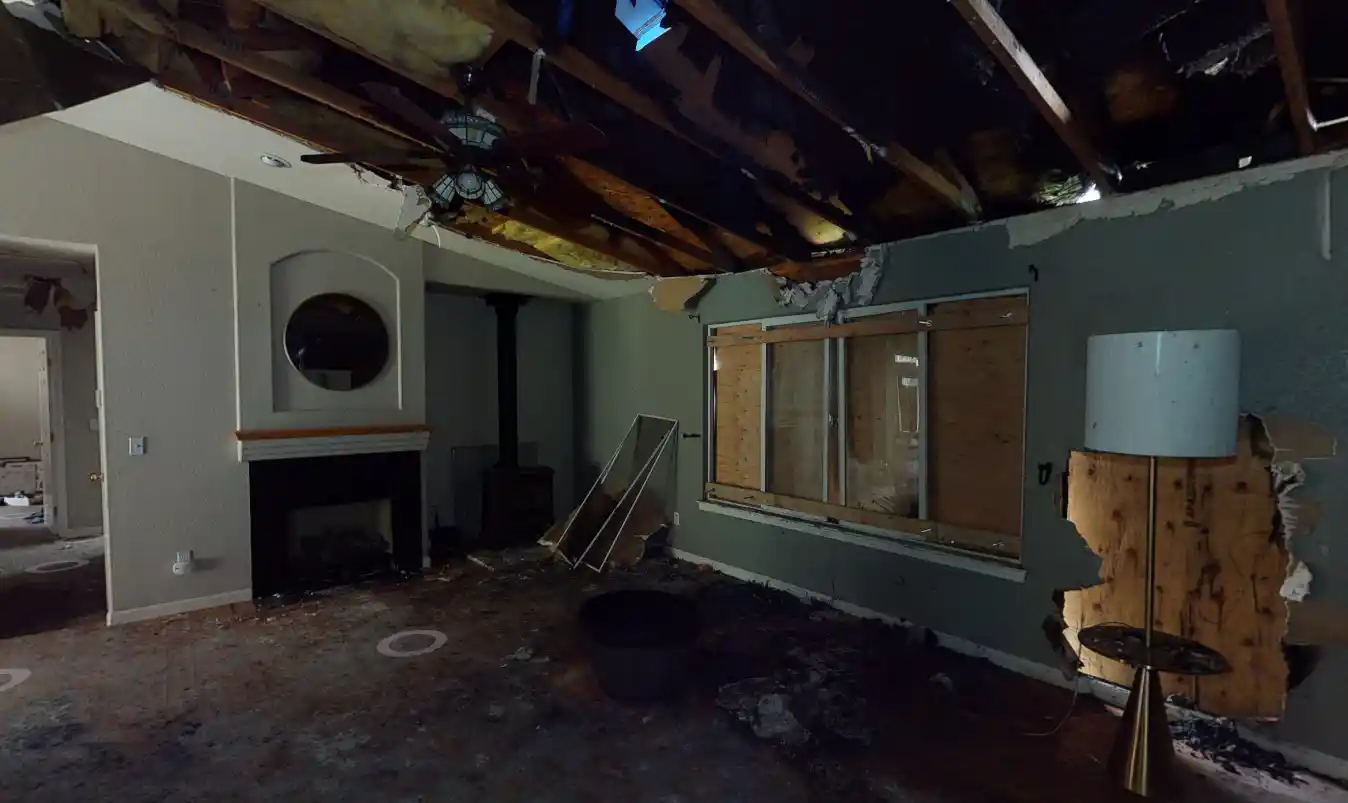
Char does not automatically mean a total loss. USDA Forest Products Laboratory guidance explains that wood loses capacity in the charred portion, while the wood beneath the char layer may retain residual strength. What has to be evaluated is the remaining cross-section, the connections, the design loads, and how long and how hot the exposure was. There’s no simple test that converts a visible amount of char into a repair-or-replace answer.
Engineered trusses deserve extra caution. They rely on both the lumber and the metal connector plates, and a standard roofing inspection isn’t enough when trusses are charred, cracked, distorted, or separated at the connections. A repair may be possible, but it has to follow an engineered repair detail, not an improvised sistering job. No handyman or roofing salesperson should design a truss repair. That’s a structural engineer’s call, made before any repair work begins.
How Insurance Affects the Decision to Repair or Replace
Fire damage usually falls under your dwelling coverage, subject to your policy’s terms and limits. Two terms drive what you’re paid. Replacement cost covers replacement with similar kind and quality without a depreciation deduction, within your limits. Actual cash value is the covered value after depreciation. Many replacement-cost policies hold back recoverable depreciation until the work is actually done, so documentation matters to the whole insurance claim. Keep a running list of damaged personal property and personal items too, since contents are usually a separate part of the claim from the structure.
Most policies expect you to document the loss and may require pre-authorization before major repairs, which is another reason to photograph everything before work starts. Ask whether your policy includes code-upgrade or ordinance-and-law coverage, since fire damage repair often triggers current code requirements that add to the scope.
Keep the firewall in mind: coverage and structural safety are separate questions. If an insurance company approves a repair, that tells you what the policy will pay, not that the structure is sound. A component-by-component written scope, breaking out covering, deck, framing, drying, and smoke work, is what lets you compare the coverage against what the house actually needs. For the deeper detail, see our articles on replacement cost versus actual cash value and what to do when the repair estimate is too low.
California and Pasadena Rules to Check Before Roof Work Begins

If your home is in California, a few state and local rules shape what’s allowed and what protects you. Verify each against current Pasadena amendments before you rely on it.
- Current code cycle: The 2025 California Building Standards Code took effect January 1, 2026, and Pasadena uses the 2025 California codes as its framework. Replacement work generally has to meet current standards.
- Permits and placards: Pasadena’s re-entry guidance uses red, yellow, and green placards. A green placard reflects a visual assessment only and does not rule out hidden hazards. The city recommends an engineer or architect when structural damage is possible.
- Fire Hazard Severity Zones: In designated zones, CAL FIRE points to a Class A fire-rated roof using an approved assembly. Confirm the property’s actual zone before assuming a requirement.
- Matching rule: Under 10 CCR §2695.9, when a replacement-cost claim requires replacement and items don’t match in quality, color, or size, the insurer must replace items in the damaged area to produce a reasonably uniform appearance. It refers to the affected area, not an automatic whole-roof replacement.
- Asbestos: The EPA recommends testing when suspect material will be disturbed, and South Coast AQMD’s Rule 1403 keeps asbestos-survey and notification requirements in place even for emergency fire demolitions. Sampling should be done by a trained professional.
CSLB rules also protect you. California home improvement work over $500 requires a written contract, the down-payment is capped at 10% or $1,000, whichever is less, and there’s a standard three-business-day right to cancel (five business days for buyers 65 or older). A seven-business-day window applies only to qualifying repair contracts in a declared disaster area. Note that temporary emergency tarping can fall under a different service-and-repair rule than a permanent reconstruction contract, so read which one you’re signing.
How to Compare Scopes From a Restoration Contractor and Spot Red Flags
A good written scope tells you what’s actually being done and what it costs. You may see fire damage repair discussed online in per square foot terms, but that per square foot math varies widely and means little for your roof until someone has been on it. An honest estimate for your property requires an on-site inspection, and anyone quoting a firm price sight-unseen is a red flag. A useful scope should include:
- Photos and measurements
- Separate line items for covering, deck, framing, drying, smoke damage cleanup, and getting the smoke smell out of affected materials, insulation, and paint
- Stated assumptions and how concealed conditions will be handled
- Engineer involvement where structural components are affected
- Clear permit responsibility
- A written change-order process
- Progress payments tied to completed work or delivered materials
Red flags worth walking away from: a firm price given sight-unseen, “sign by Friday” pressure, a roofing opinion presented as if it were an engineering determination, and no mention of permits. For example, a crew that promises to handle the roof, walls, and smoke work for a round number before anyone has set foot in the attic has not measured the actual extent of the damage. Professional roofers who know fire work will tell you what they still need to see. Pasadena recommends getting estimates from at least three contractors during disaster rebuilding, and comparing three detailed scopes is one of the clearest ways homeowners can protect themselves. This also sorts fire restoration work from unrelated trades like hail damage repair, which follows a different process entirely.
How Golden Coast Construction & Restoration Can Help
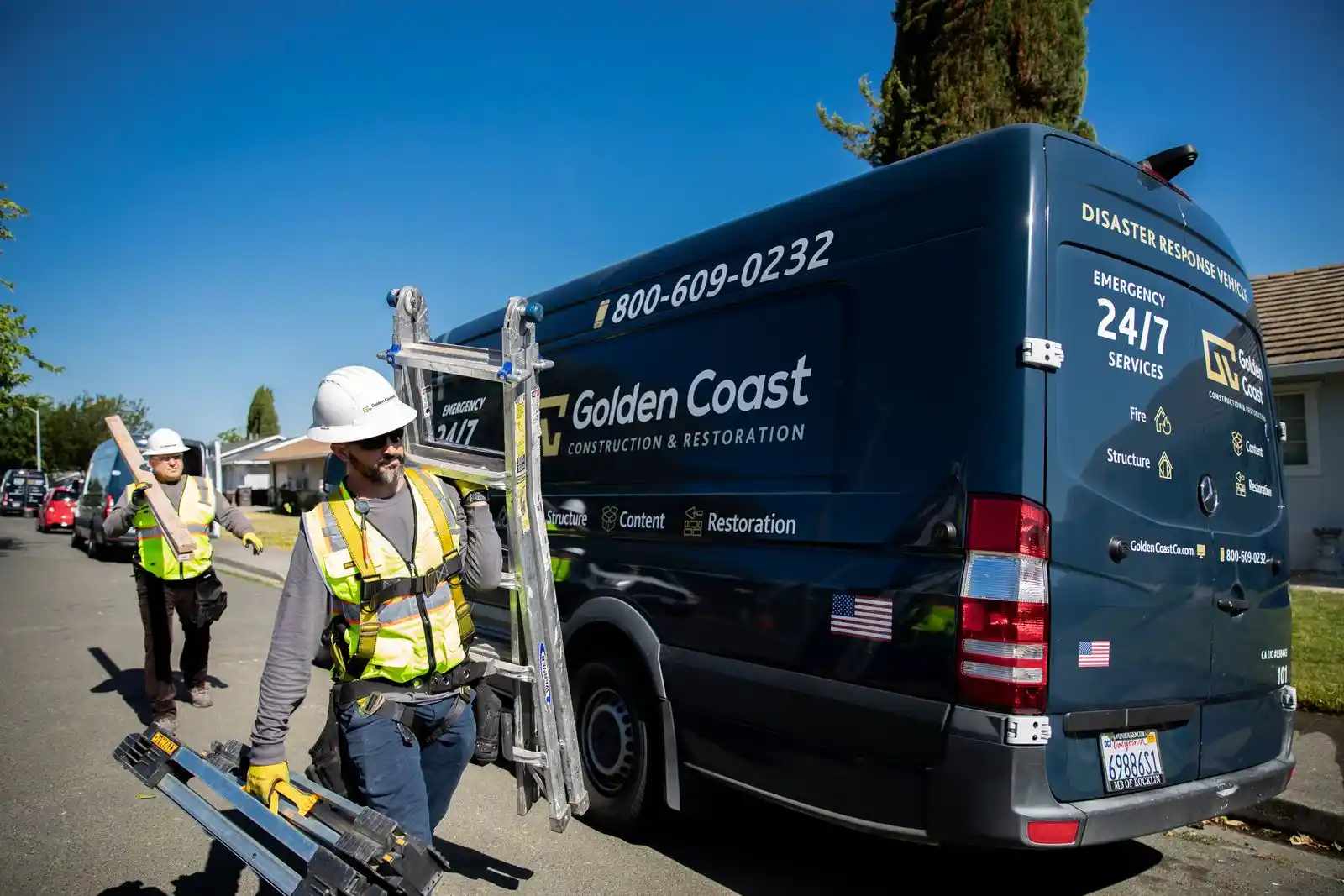
Two scopes get blurred constantly, and keeping them straight protects you. Restoration is cleaning soot from salvageable surfaces, drying, and mold prevention. Reconstruction is replacing burned decking, rafters, trusses, and the roof assembly. They’re different work, and they should be priced and documented separately.
Golden Coast Construction & Restoration is a licensed California General Contractor, CSLB #838443 (you can verify it yourself), IICRC-certified, with a permanent Pasadena-area office and 24/7 emergency board-up and roof tarping. We document the visible and concealed conditions for your adjuster, coordinate a structural evaluation where it’s needed, handle permits and code-compliant roof repairs or full reconstruction, and test for asbestos or lead where warranted. Payments are tied to completed work and milestone inspections, and you get a signed certificate of completion. A specialized licensed restoration contractor carries the whole fire restoration process, from the first tarp to move-in, with the documentation and code knowledge a handyman or a solo effort usually can’t match. When you’re ready, contact us for an on-site assessment, whether the problem is one room or the entire house. We won’t quote a roof we haven’t seen.
Frequently Asked Questions
How do I know if my roof needs replacement?
Replacement is more likely when the deck, framing, or connectors are damaged, when the fire damage is widespread, when the roof is near the end of its life, or when a repair can’t meet code. An on-site inspection decides, and an engineer should evaluate any affected structural members.
Will insurance replace the whole roof if only one section burned?
Not automatically. It depends on your policy terms and whether a partial repair can be made uniform and code-compliant. For California replacement-cost claims, the reasonably-uniform-appearance rule applies to the affected area, which can matter when materials are discontinued or no longer match.
Do I need a structural engineer after a roof fire?
Yes, when fire or heat reached the rafters, trusses, or connectors, or when there’s visible sagging or charring. A roofing contractor’s opinion is not an engineering determination, and an engineer should evaluate residual capacity before any structural repair is designed.
Should I tarp the roof before the insurance adjuster arrives?
Take reasonable temporary steps to prevent further damage, save your receipts, and avoid extensive permanent repairs until the adjuster assesses the loss, per the California Department of Insurance. A free inspection and professional tarping protect both the structure and the insurance claim evidence.
How long do I have to rebuild after a fire?
That’s driven by your policy’s time limits and local permitting, not a single number. Check your policy and contact the building department early, and ask your insurance company whether extensions are available if the rebuild takes time.