Key Takeaway
A Pasadena commercial rebuild permit is required for any fire-damaged commercial, industrial, or mixed-use building rebuilt within city limits, filed through the City’s Permit Center. Most projects also need companion approvals from Zoning, Fire Engineering, Public Works, and other departments. Ordinance No. 7444, extended through 2027, may simplify land-use entitlements for red-tagged Eaton Fire structures but does not waive building plan review, inspections, or a Certificate of Occupancy.
Yes. Rebuilding a fire-damaged commercial building inside Pasadena city limits requires City of Pasadena building permits, filed through the City’s permit office, the Permit Center. Most projects also need companion approvals and separate trade permits: zoning, design or historic review, Fire Department review, Public Works, utilities, and environmental health where a regulated business use is involved. If your structure was red-tagged after the Eaton Fire, the City’s temporary rebuild ordinance may simplify the land-use side. It does not exempt you from building plan review, inspections, permit fees, or a Certificate of Occupancy.
This is written for the business owner or manager of a commercial, industrial, or mixed-use building that burned. Below is the sequence, and the handful of facts about your property that decide which version of that sequence you’re in.
Do you need building permits to rebuild a fire-damaged commercial building in Pasadena?
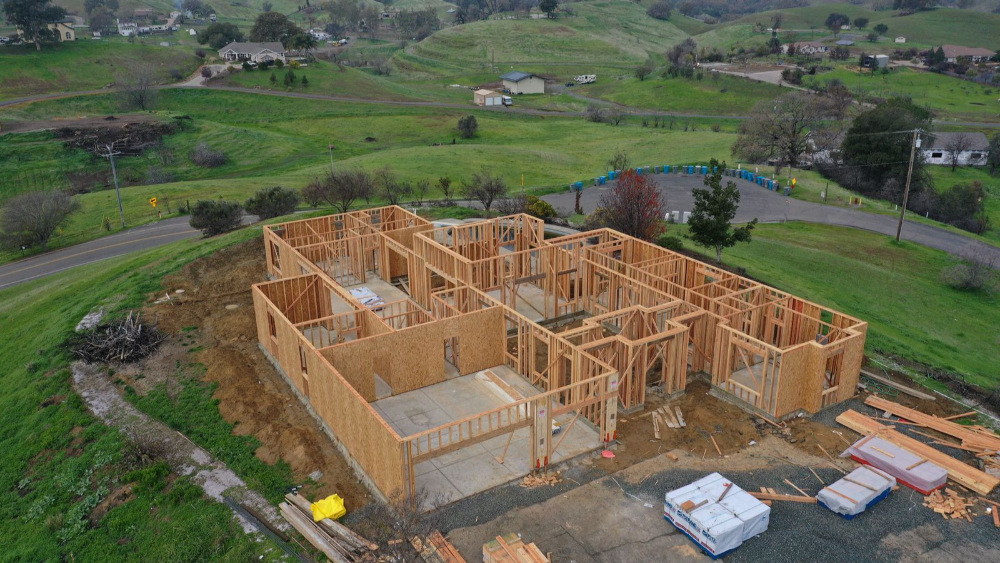
You do. Pasadena requires plan review for new commercial and industrial structures, remodels, additions, and tenant improvements, and the stated purpose is verifying that projects comply with federal, state, and city regulations. Underneath that language is public safety: egress, fire separation, and structural capacity. Applications for new construction, conversions, tenant improvements, additions, and seismic retrofits go through Permit Center Online. Alongside the main building permit, most commercial projects also have to obtain separate mechanical and plumbing permits, a permit for electrical work, and fire-protection permits where sprinklers or alarms are part of the scope.
Two distinctions carry the rest of this article, so it’s worth being plain about them now.
A land-use entitlement is permission for what you build and where: use, size, height, setbacks, parking. A building permit is permission for how you build it: structure, fire protection, accessibility, energy, mechanical, electrical, plumbing. Streamlining the first does nothing to the second.
The second distinction is between restoration and reconstruction. Smoke and soot cleaning, drying, deodorizing, and contents salvage are mitigation work. Reconstruction is rebuilding structure that was destroyed or has to come out. Only reconstruction drives the permit process described here. “Like-for-like” is a helpful phrase in zoning conversations, and it does not mean “no permit.”
City of Pasadena or Los Angeles County? Confirm jurisdiction before you apply
A Pasadena mailing address does not always mean the parcel sits inside the incorporated City of Pasadena. Residents and business owners in unincorporated Altadena and Kinneloa Mesa are under Los Angeles County agencies, with a separate County Eaton Fire recovery process, separate forms, separate fees, and separate reviewers.
Check the parcel, not the envelope. Visit the City’s zoning map and property-research portal to confirm whether the address is in city limits, and you will usually surface prior permit history at the same time. If it isn’t in city limits, start with Los Angeles County planning instead.
This check takes minutes. Filing in the wrong jurisdiction can cost weeks, and you’ll typically discover it after your design team has already drawn plans to the wrong set of standards.
What kind of commercial project is the City actually reviewing?
Permit path follows scope. A building with a burned roof and sound bearing walls travels a different route than a slab-and-ashes total loss, even on the same block. Before anyone draws anything, get an honest read on how much of the existing structure is coming back, because that answer determines which code chapters, which permits, and which departments apply.
| Condition | Likely permit path |
|---|---|
| Cleaning, mitigation, or minor fire repair | Repair permit plus applicable trade permits |
| Structural repair with substantial standing portions | Building permit under the Existing Building Code, with structural review |
| Partial demolition and reconstruction | Demolition permit plus reconstruction plan review |
| Total commercial loss | New construction plan review |
| Change of use or occupancy group | Added zoning, accessibility, egress, fire, and possibly parking review |
| Historic commercial property | Design and historic review alongside building review |
| Red-tagged Eaton Fire structure | Ask Planning whether Ordinance No. 7444 applies |
A change in occupancy group, footprint, or site layout is the single biggest scope surprise for commercial owners. Turning a burned retail shell into a restaurant, or splitting one tenant space into three, pulls in zoning, accessibility, egress, parking, and fire review that a straight replacement would not have triggered. It also usually raises the valuation the City uses to calculate your permit fees.
Does Pasadena’s Eaton Fire Rebuild Ordinance apply to commercial properties?
Sometimes, and the answer belongs to the City, not to your contractor.
Ordinance No. 7444 took effect March 27, 2025. On May 5, 2025, Resolution No. 10125 extended it by 22 months and 15 days. It is still a temporary ordinance, so confirm its current status before you rely on it.
The ordinance applies to structures red-tagged by the Building Official because of the Eaton Fire. The Planning and Community Development Director determines eligibility during plan check. For eligible structures, it can allow rebuilding without a separate city-issued land-use entitlement when location, size, height, and other listed conditions are met. What it does not do: waive unmodified code provisions, eliminate building plan review, or excuse you from the inspections that follow.
Here’s the correction most write-ups skip. The regulations differ by zoning district. The widely repeated “10% or 200 square feet” allowance is not a blanket commercial rule. The ordinance’s 200-square-foot provision is written for certain residential projects, and the 10% size and height provisions apply in specified situations only. If you are also weighing a residential rebuild or accessory dwelling units on the same parcel, those provisions read differently again. Request a zoning determination from Pasadena Planning tied to your parcel and your pre-fire structure, in writing, before your architect commits to a footprint.
What if the building was legally nonconforming before the fire?
Many older Pasadena commercial buildings sit closer to a lot line, taller, or denser than current zoning would allow today. That’s legal nonconformity, and the City’s ordinance materials address nonconforming nonresidential structures under Pasadena Municipal Code Section 17.71.070.
Document the legal pre-fire condition before redesign begins: footprint, floor area, height, setbacks, occupancy, and use, backed by permit records and approved plans where they exist. That file is what lets Planning confirm what you’re entitled to rebuild. It also gives your insurer a documented baseline for scope, which matters more than most owners expect once the estimate reconciliation starts.
Pasadena permit fees, plan review fees, and the City’s fee schedule

Are permit fees waived for a commercial fire rebuild? Generally, no. Pasadena’s Fire Rebuild Fee Waiver and Refund Program is limited to qualifying owner-occupied single-family residences and condominiums, so it reaches homeowners rebuilding their own homes rather than commercial owners. That program ranks well and is easy to find, which is exactly why commercial owners keep assuming it covers them. It doesn’t.
Permit fees and plan review fees for commercial work are set by the City’s published fee schedule and driven by project valuation and scope. Plan review fees are typically collected at initial submission; the balance of the permit fees is usually collected before the permit is issued. Additional fees can attach to demolition permits, grading, encroachment, utility connections, and any re-inspection the building inspector has to make because work wasn’t ready. Ask Building & Safety for a project-specific fee determination rather than budgeting from a residential program or a blog post written for a different city.
One note on cost that applies to this whole article: we don’t publish rebuild figures, per-square-foot numbers, or permit-cost estimates, because they can’t be honest without seeing the building. Anyone who quotes your total sight-unseen is guessing, and a guess in writing is still a guess.
Which building code applies to a commercial rebuild permit filed now?
Pasadena lists the 2025 California Building Standards Code, effective January 1, 2026. That includes the California Building Code, Existing Building Code, Fire Code, Electrical, Mechanical and Plumbing Codes, Energy Code, CALGreen, the Historical Building Code, and the Wildland-Urban Interface Code, plus Pasadena’s local amendments in Municipal Code Title 14.
The City’s code page also shows the 2022 codes as an optional Eaton Fire rebuild path. Be careful with that. State explanations of the code carryover are framed primarily around eligible residential structures. For commercial projects, expect the 2025 codes unless Pasadena Building & Safety confirms in writing that your project qualifies for a different path. Designing to the wrong edition is an expensive correction cycle with your plan checker.
The Pasadena permit process, step by step

Every commercial rebuild moves through the same basic sequence, even when the timing varies wildly.
- Research the parcel. Confirm jurisdiction, zoning, prior permits, and historic status before design begins.
- Get a scope and zoning determination. Ask Planning what you may rebuild and under which regulations, in writing.
- Prepare the plan set with your architect and engineer, including the consultant documents each reviewing department requires.
- Submit the application package through Permit Center Online. Incomplete applications are not accepted for review.
- Plan check. A plan checker in each department reviews the plans and issues correction comments.
- Respond to corrections and resubmit. Expect more than one round on a commercial project.
- Pay the balance of fees and obtain the permits, including the subtrade permits your subcontractors need.
- Build, with inspections at each required milestone.
- Close out with final inspections from the various departments that reviewed the project, then the Certificate of Occupancy.
Which permits can be issued over the counter?
Simple work that does not require plan review can sometimes be issued over the counter, and some minor trade permits can be obtained online without a visit at all. If the project requires plans, it goes into full review instead. A commercial fire rebuild almost never qualifies for over the counter review. Pasadena reserves counter issuance for scopes a reviewer can evaluate on the spot, and a burned structure with structural, fire-protection, and accessibility questions is not that. Ask the Permit Center whether any piece of your work, such as a temporary power pole or a sewer cap, can go over the counter while the main plans are in review. That single question can keep a site moving.
Working with your plan checker
Once the application is accepted, your project is assigned to a plan checker, sometimes called a plans examiner, in each reviewing department. Correction letters are not a judgment on your design team. They are the mechanism for getting the project approved, and the fastest projects are the ones that answer every comment directly, sheet by sheet, with a written response letter that says exactly where each correction was made.
If a comment is unclear, request a call or a meeting rather than guessing. One conversation with the person actually reviewing your plans routinely saves a full resubmittal cycle. Keep a single point of contact on your side so the City is not receiving three different answers from three different consultants.
What to do before you submit plans to the Permit Center
Most stalled commercial rebuilds stall on things that should have been handled before the first sheet was drawn.
- Pull your pre-fire permit records and approved plans from the City. These establish legal use, occupancy, footprint, floor area, height, and setbacks.
- Confirm fire-debris clearance is complete for the parcel. Eaton Fire properties that opted out of the government program used a private debris-removal process with its own documentation. Foundation and rebuild plans shouldn’t go in until that’s closed out.
- Get the demolition side right. Demolition requires its own permit, and Pasadena Municipal Code requires inspection by qualified individuals for asbestos or hazardous materials before you can obtain that permit. Where those materials are found, abatement documentation and a completion certificate must be submitted first.
- Handle the utility and site items that ride along with demolition: utility notifications, maintaining water service during demolition, sewer and drain capping permits and inspections, filling basements or sumps, and construction fencing where required.
- Order structural and geotechnical evaluations as needed. Where a soils report applies, Pasadena’s checklist requires one less than two years old.
Coordinate with your insurer before removing anything that documents pre-fire conditions. Once a wall assembly is in a dumpster, it stops being evidence of what was there.
What belongs in a commercial rebuild plan set?

File online. Pasadena’s application page requires online submission for new construction, tenant improvements, and additions. The downloadable plan-review checklist, revised December 9, 2025, still asks for three plan sets plus an electronic copy while elsewhere noting that only one approved hard copy is needed at the job site. That inconsistency is real. Lead with the online filing, then confirm with your assigned plan checker whether anything still has to arrive as paper or on a flash drive.
The checklist identifies, where applicable:
- Site plan or plot plan, existing and proposed floor plans, roof plans, exterior elevations, and building sections
- Foundation and framing plans, plus structural calculations
- Mechanical, electrical, and plumbing plans
- Energy-compliance documents and CALGreen
- Grading plans and drainage
- A soils report less than two years old where required
- Accessibility and means of egress documentation
- Fire sprinklers, alarms, fire flow, and site access
- Construction and demolition waste-management documentation
- Environmental Health plans for restaurants and other regulated uses
The checklist also sets minimum requirements for sheet size, 24 x 36 inches. Incomplete plan submissions are not accepted for review, so a set missing one of the required documents doesn’t get a partial start, it gets returned. A complete submittal is what starts the clock.
Which City of Pasadena departments review commercial projects?
| Department | What it reviews / when it applies |
|---|---|
| Building & Safety | Structural, accessibility, energy, and MEP plan review; inspections; permit issuance |
| Zoning | Use, density, height, setbacks, parking; Ordinance No. 7444 eligibility |
| Design & Historic Preservation | Design review for new nonresidential construction and major alterations: Preliminary Consultation, Concept Design Review, Final Design Review, sometimes consolidated at staff discretion |
| Fire Engineering | New construction, tenant improvements, additions, site plans, fire-protection systems, vegetation-management plans |
| Public Works | Right-of-way, grading, sewer, encroachment permits |
| Water and Power | Utility services, meters, fire flow supply |
| Transportation | Access, circulation, parking where triggered |
| Environmental Health | Plan approval before construction for restaurants, markets, commercial kitchens, body-art facilities, cannabis retail, pools, and massage establishments |
| C&D Waste Management | All new structures, all demolitions, nonresidential additions of at least 1,000 square feet, and tenant improvements at the City’s published valuation threshold |
Fire Engineering accepts digital plans, but its page states that a completed fire-permit application is submitted in person at the Permit Center. Expect to provide plans, equipment listings and specifications, calculations, and proof of a valid California contractor’s license tied to the plan.
If your building is historic or in a landmark district, the California Historical Building Code offers alternative standards for qualifying buildings. Talk to Design & Historic Preservation before plans are finalized, not after. Some of these reviews run concurrently and some are strictly sequential, and knowing which is the difference between a coordinated schedule and a stalled one.
How long does Pasadena commercial plan review take?

The City publishes targets for individual reviews. Roughly 2 to 4 weeks is Pasadena’s general review time for plans too complex for counter processing. Fire Engineering review typically runs about 3 weeks, excluding weekends, the alternate Fridays the division is closed, and holidays. Environmental Health targets 20 business days for a new regulated-facility plan and 10 business days on resubmittal.
Those are per-review targets, not total permitting time. A commercial rebuild usually moves through multiple departments, and each correction cycle restarts a clock. Submittal quality, project complexity, and current workload all move the number.
Once you obtain the permits, other deadlines start. City guidance says permits are valid for 180 days, with regular inspections keeping the permit active. A permit application expires if no permit is issued within one year of application. The current administrative code identifies one 180-day extension, with an extension request required no later than 30 days after expiration, subject to conditions and fees. Confirm your project’s specific expiration date with Building & Safety.
No contractor can promise you a permit date. If someone does, they’re committing to something they don’t control.
Inspections, final approvals, and the Certificate of Occupancy
Construction runs on milestone and trade inspections: foundation, framing, rough MEP, insulation, fire-protection rough and final, then the finals for each department with an approval on your project. The permit holder is responsible for requesting each inspection in advance and keeping the approved plans and permit card on site, because the building inspector signs off against the stamped set, not against a verbal description of what changed. Missing an inspection at the wrong moment means opening finished work back up, and re-inspection fees follow work that wasn’t ready.
Pasadena requires a Certificate of Occupancy for new commercial, institutional, and industrial buildings, commercial additions, and tenant improvements after the project has been finalized. Every required department has to complete its final inspection first.
A Temporary Certificate of Occupancy may be considered when no unresolved life-safety issue remains. The City’s stated issuance target is 24 hours after all required departments approve it. But a temporary certificate is discretionary, and it is not a scheduling tool. Don’t build a lease commencement date, a reopening announcement, or a tenant delivery promise around a TCO you don’t have in hand.
Choosing a licensed contractor, and why the Pasadena business license matters

Pasadena requires the contractor pulling the permit to hold the appropriate California contractor’s license, workers’ compensation coverage, authorization from the license holder to use the license, and a current City of Pasadena business license. A contractor without that business license can be stopped at the counter on the day you expected to obtain your permits. The City verifies license status through the Contractors State License Board. You can check any license yourself in about a minute using CSLB’s “Check a License” tool, and it’s worth doing before the first meeting, not after.
What actually protects you on a commercial job:
- A verified license with the right classification for the work, plus a current Pasadena business license
- A written scope tied to the approved plans, not to a walk-through description
- Milestone payments tied to documented, inspected progress
- Change orders in writing, priced, before the work happens
One honest caveat: California’s residential home-improvement contract protections, including the down-payment cap and the three-day right to cancel, are written for residential home-improvement contracts. Don’t assume they govern a commercial agreement. On a commercial rebuild, your protection comes from the contract you sign, verified licensing, and documentation at every milestone.
And if any person pressures you to sign by a deadline they invented, that’s the signal to slow down. Nothing about a permit process rewards a rushed signature.
Frequently asked questions
How much does a contractor charge to pull permits?
City permit fees and plan review fees are set by Pasadena’s published fee schedule and driven by project valuation and scope, so no one can name your number without your plans. A contractor may pass those City fees through at cost or bill permit coordination services as a separate line item, and both are legitimate as long as it’s disclosed. Ask which approach they use, in writing, before you sign.
What happens if commercial work is done without a permit in Pasadena?
Unpermitted work can trigger stop-work orders, investigation fees, and retroactive permitting, and finished assemblies often have to be opened up and re-inspected. It can also block your Certificate of Occupancy, complicate the insurance claim, and surface as a problem at sale or refinance years later.
How do I know whether the City of Pasadena or Los Angeles County issues my permits?
Check the parcel against the City’s zoning map and property-research portal rather than relying on the mailing address. Properties with Pasadena addresses in unincorporated Altadena or Kinneloa Mesa are under Los Angeles County jurisdiction and use the County’s separate Eaton Fire recovery process.
Does a like-for-like commercial rebuild still need design review?
Design review is generally required for new nonresidential construction and major alterations, and minor alterations can trigger it depending on location. An eligible Ordinance No. 7444 project may avoid a separate land-use entitlement, but that is a Planning determination made during plan check, not something to assume from your side.
Is asbestos testing required before demolishing a fire-damaged commercial building?
Pasadena Municipal Code requires inspection by qualified individuals for asbestos or hazardous materials before a demolition permit is issued. Where those materials are found, abatement documentation and a completion certificate must be submitted before the City will issue the permit.
Getting a straight read on your building
Golden Coast Construction & Restoration is a California-licensed general contractor, CSLB #838443, verifiable through CSLB’s public license lookup. We’re IICRC-certified, and we’ll be direct about what that covers: certification supports the fire-restoration and mitigation phases. It does not replace a contractor’s license, an architect’s or engineer’s seal, demolition clearance, or City approvals. Rebuilding is governed by plans, permits, and inspections.
What a specialized fire-reconstruction contractor brings to a commercial rebuild is coordination. The structural, architectural, fire-protection, hazardous-material, insurance, and permit documentation all have to agree with each other, and that’s where fragmented or unvetted work usually breaks down. We keep a permanent Pasadena office, work directly with adjusters, tie payments to documented milestones, run QA inspections along the way, and close with a signed certificate of completion.
An honest scope requires seeing the building. If you’d like a site inspection and a straight read on where your property sits in this process, we’re glad to come out and walk it with you.