Key Takeaway
In a Placer vs Sacramento County rebuild permit comparison, jurisdiction depends entirely on your parcel’s location, not your mailing address. Placer County prioritizes fire rebuilds with many simple permits issued same day and complex ones in two to three days. Sacramento County uses electronic plan review with 180-day application windows and treats removal of 50% or more of a structure within one year as new construction, triggering stricter code requirements.
You don’t get to pick between Placer County and Sacramento County. The parcel’s address decides which building department issues your rebuild permit, and county building departments cover unincorporated areas only. If your home sits inside Roseville city limits, the City of Roseville issues the permit, not Placer County. Each county runs its own clocks and its own repair-versus-new-construction triggers, and that is where schedules slip.
County and state rules change; verify anything time-sensitive with the department directly.
Which building department issues your building permit?

Placer County Building Services, part of the Community Development Resource Agency, and Sacramento County Building Permits & Inspection have authority in unincorporated areas only. Residents inside any city use that city’s building division. The City of Sacramento and the County of Sacramento are separate agencies with separate portals.
Three steps, in order: look up the parcel on the county’s online parcel viewer, read the Jurisdiction field (Sacramento County warns residents not to rely on the mailing city or ZIP code), then confirm by phone with that department before anyone draws a plan. Getting this wrong means the wrong portal, the wrong forms, and zoning assumptions that don’t apply.
Placer vs Sacramento County rebuild permit: the differences at a glance
Both counties permit the same work under the same statewide building codes. The differences sit in classification thresholds and expiration clocks.
| Issue | Unincorporated Placer County | Unincorporated Sacramento County |
|---|---|---|
| How you apply | Online or on paper; finish the way you started. | Electronic plan review, tracked by comment cycle. |
| Repair vs. new construction | Scope judged under current code by the Building Official. | Removing 50% or more of an R-3 or U building within one year counts as new construction. |
| Application expiration | One year after filing; one one-year extension on written request, a second possible. | 180 days if no permit issues; extendable to 365 days for circumstances outside your control. |
| Issued permit duration | Two years. Up to two one-year extensions for justifiable cause. | Two years; work must start within 365 days, with no 365-day gap between inspections. |
| Priority handling | Published catastrophe priority process for previously permitted, occupied buildings. | No blanket fire-rebuild timeframe published; per-cycle estimates instead. |
| Fire review | Fire district, Placer County Fire, or CAL FIRE approval before issuance and occupancy. | Fire review as applicable; sprinklers set by the Building Official. |
No fee comparison here on purpose: permit fees are valuation-based, and the county calculates them from your submitted plans.
Is your project a fire repair or a rebuild?

This classification drives everything else. Roughly four tiers:
- Limited repair: finishes and smoke-affected surfaces.
- Structural repair: framing, roof, or load-bearing members in part.
- Substantial reconstruction: a large share of the building removed and rebuilt.
- Total-loss rebuild: the structure comes down and goes back up.
Restoration means cleaning, mitigation, drying, and salvage. Rebuilding means reconstruction after major structural or total loss. They are not interchangeable, and the tier changes your plan set, the code edition applied, sprinkler and life-safety questions, and how scope is documented for the claim. The 2025 California Building Standards Code took effect January 1, 2026 and applies to applications filed on or after that date, along with local amendments. The Building Official makes the call, not your contractor and not your insurance company.
How the Placer County building permit path works after a fire
Confirm the parcel is unincorporated, then apply online through a portal account or on paper. Placer’s catastrophic-damage guidance says repair and rebuild permit applications for previously permitted, occupied buildings receive priority, with many simple permits issued same day and complex repairs in two to three days.
Permit requirements for a total-loss rebuild go well beyond simple repairs: architectural and engineering plans, planning clearance, fire review, utility coordination, sometimes grading review. After a wildfire, a whole community files permit applications in the same few months, and queues lengthen.
One useful Placer detail: site-plan guidance generally exempts fire repairs and rebuilds from certain Fire Safe access triggers when ownership stays the same and the existing driveway is reused.
How Sacramento County plan review and permit applications work

Submittal and plan review are electronic, with estimated timeframes shown per cycle. Expect an intake check for completeness before technical review begins. You submit, the reviewing departments return a comment letter, your designer must respond to each comment with the details the reviewer asked for, and you resubmit. Unresolved comments are the most common reason permit applications quietly die at the 180-day mark, so track progress in the comment log yourself.
Applications filed on or after January 1, 2026 follow the 2025 code plus county amendments. If removal reaches 50% or more of an R-3 or U building within one year (measured by linear wall length, square footage, or both), the project is treated as new construction, and the Building Official determines sprinkler requirements. Once the permit issues, work must begin within 365 days, and no 365 continuous days can pass without an inspection.
Submitting plans does not authorize construction; only an issued building permit does. A foundation-only or partial permit is something to ask the county about, never assume.
Can you rebuild on the same footprint?
“Grandfathered” isn’t an answer, because five tests can apply: a nonconforming setback, a nonconforming use, a nonconforming lot, the percentage of structure removed, and the percentage of value lost.
Sacramento’s zoning provision allows a legally nonconforming building damaged by no more than 50% of its value to be reconstructed if work begins within one year and is diligently completed; above that, it generally must conform to the rules for new buildings. That is a different measurement from the building-code test, which counts how much structure is removed.
Placer allows reconstruction of a building nonconforming as to height or setback only if the new work doesn’t encroach farther than the existing construction. A nonconforming use may require a minor use permit, reconstruction within 24 months, and no added floor area. Get the planning determination in writing.
Can the old foundation stay?
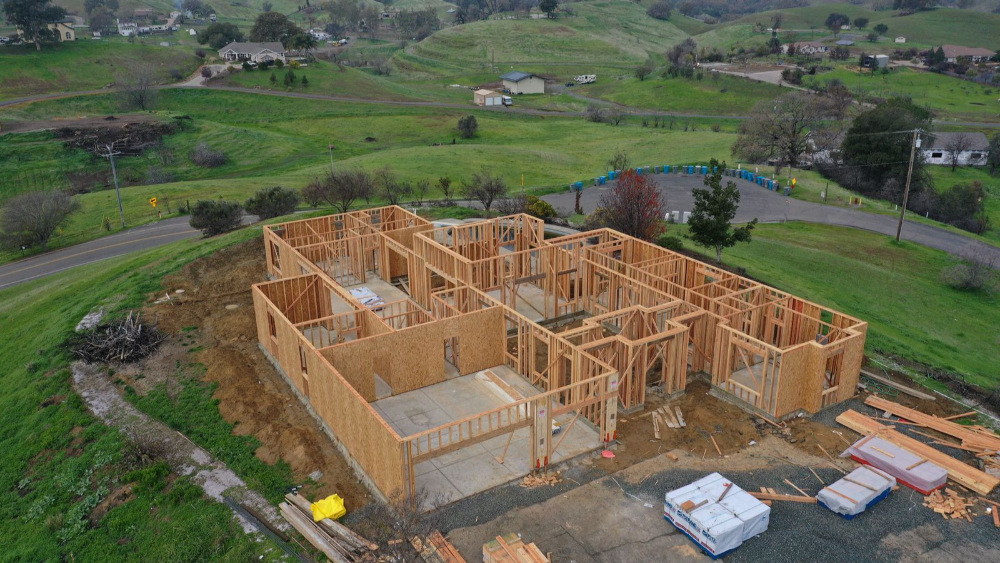
Placer County’s wildfire debris removal guidance generally includes foundations and slabs in the material removed unless the Building Division approves reuse. Keeping one takes a letter from a licensed civil or structural engineer explaining why it remains suitable, with test results, plus Building Division and Environmental Health approval. Sacramento owners should ask for a determination based on fire exposure and an engineering evaluation; a slab that looks sound can still have lost strength. Build schedule and budget room in either way, since replacing a slab adds weeks.
Permit requirements: what your building permit package will likely include
A complete package usually includes the following, though scope drives the requirement:
- Damage and structural assessment
- Site plan
- Architectural plans
- Structural calculations
- Energy documentation
- Electrical, plumbing, and mechanical details, including water heater location, ventilation, and kitchen and bathroom fixtures
- Foundation evaluation if reuse is proposed
- Fire-authority approval
- Demolition or debris documentation
- Contractor license number with an affirmation that it’s active
An insurance estimate is a claim document, not a code-compliant plan set. The two often differ, and the permitted scope governs construction. Additionally, ask the county whether demolition and debris removal need their own permit.
Two kinds of upgrades show up in a fire rebuild. Code-required upgrades come from the code edition in force when you file; examples include smoke alarms, bedroom egress windows, and insulation. Voluntary upgrades are yours, like enlarging a bathroom. Keep the two separated line by line, because ordinance-or-law coverage generally addresses the first and not the second.
Permit mistakes that cause delays

- Applying to the wrong jurisdiction.
- Calling a reconstruction project a remodel.
- Assuming the old footprint is automatically protected.
- Starting permit-required structural work before issuance.
- Missing the application or inspection clocks, which restarts work you already paid for.
- Pulling an owner-builder permit while someone else runs the job.
CSLB is clear that an owner-builder accepts responsibility for permits, inspections, code compliance, the schedule, subcontractors, and paying labor and suppliers. When an unlicensed operator suggests you pull the building permit, the liability moves to you. Verify the license online through CSLB before you hire anyone; the lookup is free.
Frequently Asked Questions
What happens if you don’t pull a permit for work that requires one?
It can trigger a stop-work order and retroactive permitting, which sometimes means opening finished drywall so an inspector can see the work. Unpermitted work also surfaces at resale, appraisal, or on a future claim.
Does the homeowner or the contractor pull the rebuild permit?
A licensed contractor doing the work normally pulls it, fills out the application, and provides an active license number. They also book each inspection appointment, and an inspector visits only when the job is called in.
Getting an accurate read on your property before you apply
A contractor who handles fire reconstruction regularly confirms jurisdiction before design begins, keeps restoration and reconstruction scope separate in the paperwork, carries every plan review comment to resolution, and schedules inspections so the permitted scope, the claim, and the final certificate of completion match.
Golden Coast Construction & Restoration works from a permanent office in Roseville, is IICRC-certified, and holds California General Contractor license CSLB #838443, verifiable online. We use milestone payments. Two California protections worth knowing before you sign: your down payment is capped at 10% of the contract or $1,000, whichever is less, and you have a three-day right to cancel. Get three estimates.
No honest contractor can quote this sight-unseen or promise a county approval date. If you want an on-site assessment and a straight read on which department controls your parcel, we’re glad to visit and take a look.